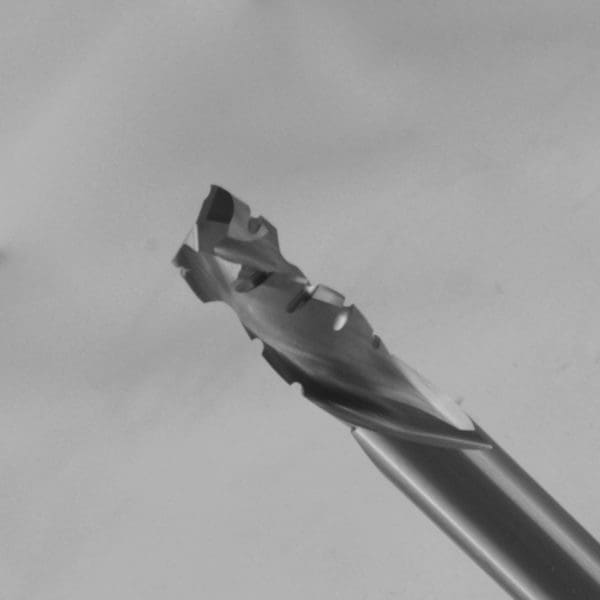
A compression bit combines upcut and downcut cutting geometries in one router bit. The opposing cutting forces direct material toward the center of the panel, helping produce clean edges on both the top and bottom surfaces.

2-Flute Compression Router Bit for MDF & Particleboard
In stock
Price range: $53.00 through $373.00
Typical Machining Range: 16,000–18,000 RPM at 400–600 in./min. Actual parameters may vary based on tool diameter, material, machine rigidity and workholding. For application-specific settings, see our Chip Load Calculator.
The compression bit for MDF and particleboard is a 2-flute solid carbide CNC router bit engineered for clean, efficient machining of wood-based panel materials. Compression geometry combines a lower upcut with an upper downcut to direct cutting forces toward the center of the panel, helping produce clean top and bottom edges during through-cutting operations.
This tool is manufactured from a carbide grade specifically selected for MDF and particleboard machining, rather than using a one-grade-fits-all approach. GDP Tooling utilizes different carbide grades and binder compositions across our compression-bit range to optimize performance for specific materials.
Tools shown are RH rotation. LH rotation is available upon request.
For 3/4″ applications, our carbide insert compression router bit may provide a more economical alternative.
Have a Question?
Ask about this product
2-Flute Compression Router Bit for MDF & Particleboard
Product FAQs
Compression bits are commonly used for plywood, melamine, laminated particleboard, MDF, veneered panels and other sheet materials where clean edges on both faces are required.
The upcut portion helps produce a clean bottom edge, while the downcut portion helps prevent chipping on the top surface. When the material is positioned within the compression zone, both faces can be machined cleanly in a single pass.
The upcut portion must remain within the thickness of the material for true compression cutting. If the upcut section extends above the top surface, it can cause chipping or tear-out on the top edge. For machining on a flat table/spoilboard, a shorter upcut is preferable (usually +/- 3/16″). For Pod/Rail machines, a longer upcut, such as 5/16″ is appropriate.
Yes. Through-cutting laminated and veneered panels is one of the primary applications for compression router bits because the geometry is designed to produce clean top and bottom edges simultaneously.
Choosing the correct compression bit involves more than selecting the right diameter and cutting length. Material, panel thickness, feed speed, flute configuration, upcut length and carbide grade all influence tool performance and tool life.
A common misconception is that a 3-flute compression bit produces a better finish than a 2-flute tool. It does not. The primary advantage of a 3-flute design is its ability to accommodate higher feed speeds while maintaining the proper chip load per cutting edge. This can significantly increase productivity on CNC machines capable of higher feed rates.
Carbide grade is equally important. GDP Tooling offers compression bits manufactured from three different carbide grades using different binder compositions, allowing the cutting material to be matched more closely to the material being machined. For this reason, we differentiate between compression tools optimized for MDF, melamine and solid wood, rather than treating all compression bits as interchangeable.
Panel thickness and upcut length must also be considered. For clean top and bottom edges, the upcut portion of the tool must remain below the top surface of the material so that the compression geometry functions correctly.
MDF contains densely compressed wood fibers combined with resins and binders, making it highly abrasive to cutting tools. Selecting a carbide grade and binder composition suited to MDF can improve cutting performance and tool life.
The compression bit for MDF and particleboard is designed for CNC machining of abrasive wood-based panels where clean top and bottom edges and dependable tool life are required.
Compression geometry combines opposing cutting directions within one tool. The lower upcut section pulls chips upward and helps produce a clean bottom edge, while the upper downcut section directs cutting forces downward at the top surface. With the compression transition correctly positioned within the material, the opposing cutting forces help minimize edge breakout on both faces.
Carbide selection is particularly important when machining MDF and particleboard. These materials are highly abrasive due to their combination of wood fibers or particles, resins and binders. GDP Tooling therefore does not use a single carbide formulation across its entire compression-bit range.
Our compression tools are manufactured using different carbide grades and binder compositions selected according to the material being machined. This Series 6229M tool uses a carbide grade specifically selected for MDF and particleboard applications. Separate compression tools are available for melamine, plywood and solid wood.
For optimum results, select the correct cutting diameter, cutting length and upcut length for the panel thickness and machining operation.