PCB Saw Blades for FR-4, PTFE &
Advanced Materials
PCB Saw Blades: Carbide and PCD Solutions for High-Performance PCB Cutting
Modern printed circuit boards are harder on cutting tools than ever before.
Today’s PCB manufacturers routinely machine abrasive FR-4 laminates, Rogers materials, PTFE composites, ceramic-filled RF substrates, aluminum-backed circuit boards, and multilayer constructions with high copper densities. These advanced materials improve electrical performance, but they also accelerate saw blade wear, increase cutting temperatures, and create new challenges for edge quality and dimensional accuracy.
Selecting the proper PCB saw blade is one of the most important factors in maintaining production efficiency, minimizing scrap, and achieving consistent cut quality.
Whether you are cutting FR-4 panels, depaneling assembled boards, slotting multilayer laminates, or machining advanced RF materials, blade design directly impacts tool life, throughput, and manufacturing costs.
Why PCB Materials Are Difficult to Cut
PCB machining combines several highly abrasive materials into a single workpiece.
A typical PCB may contain:
- Fiberglass reinforcement
- Copper foil layers
- Epoxy resin systems
- Ceramic fillers
- PTFE compounds
- Aluminum substrates
- High-silica reinforcement materials
Each component affects cutting performance differently.
Fiberglass is particularly aggressive because it rapidly wears cutting edges through abrasion. Ceramic fillers further accelerate wear, while copper layers can contribute to burr formation and edge smearing if tooling geometry is not properly optimized.
As PCB materials become more complex, conventional tooling often struggles to maintain acceptable cut quality throughout production runs.
Common PCB Cutting Problems
Manufacturers frequently experience:
- Excessive saw blade wear
- Burr formation
- Fiber pullout
- Delamination
- Copper smearing
- Resin melting
- Poor edge finish
- Dimensional inconsistency
- Increased scrap rates
- Reduced blade life
In many cases, these issues can be traced directly to improper blade selection, unsuitable tooth geometry, or insufficient wear resistance for the material being machined.
Solid Carbide PCB Saw Blades
Solid carbide saw blades remain one of the most widely used solutions for PCB cutting applications.
Premium carbide grades provide an excellent balance between cost, performance, rigidity, and wear resistance.
Benefits of Carbide Saw Blades
High-performance carbide saw blades offer:
- Excellent edge sharpness
- High stiffness
- Good wear resistance
- Consistent dimensional control
- Reduced vibration
- Economical operating costs
For many PCB manufacturers, carbide tooling delivers an ideal combination of productivity and affordability.
Fine-Grain Carbide Makes a Difference
Not all carbide grades perform equally.
Sub-micron and ultra-fine grain carbide structures provide:
- Better edge retention
- Higher transverse rupture strength
- Improved fracture resistance
- Reduced micro-chipping
- Longer operational life
These characteristics become increasingly important when machining glass-reinforced laminates and ceramic-filled materials.
The Importance of PCB Saw Blade Geometry
Tooth geometry plays a critical role in PCB machining performance.
A blade designed for woodworking or metal cutting will rarely perform well when cutting circuit board materials.
PCB applications often require specialized features such as:
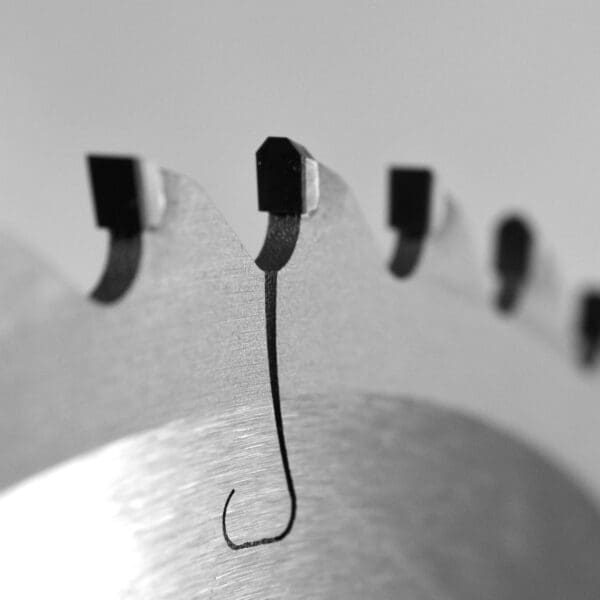
- Triple-chip tooth designs
- Trapezoidal tooth forms
- Negative hook angles
- Ultra-thin kerf configurations
- Precision side clearances
- Tight runout tolerances
Proper geometry helps minimize cutting forces while reducing the risk of:
- Delamination
- Fiber breakout
- Burrs
- Copper damage
- Surface defects
Even small geometry variations can significantly impact process stability and finished part quality.
PCD Saw Blades for PCB Manufacturing
When maximum tool life is required, many manufacturers choose PCD saw blades.
PCD stands for Polycrystalline Diamond, a cutting material specifically engineered to provide exceptional wear resistance in abrasive machining environments.
Because fiberglass and ceramic-filled laminates rapidly degrade conventional cutting edges, PCD tooling often delivers dramatically longer service life.
Advantages of PCD Saw Blades
Compared with carbide tooling, PCD saw blades typically provide:
- Significantly longer tool life
- Superior wear resistance
- Lower friction
- Reduced cutting temperatures
- Better dimensional consistency
- More stable process control
- Fewer blade changes
- Increased machine uptime
For high-volume PCB production, these advantages often outweigh the higher initial tooling investment.
PCD vs Carbide Saw Blades
One of the most common questions manufacturers ask is whether PCD tooling is worth the additional cost.
The answer depends largely on production volume, material abrasiveness, and tooling consumption rates.
| Feature | Carbide Saw Blades | PCD Saw Blades |
|---|---|---|
| Initial Cost | Lower | Higher |
| Tool Life | Excellent | Exceptional |
| Wear Resistance | Very Good | Outstanding |
| Edge Retention | Very Good | Outstanding |
| Downtime Reduction | Moderate | Significant |
| High-Volume Production | Good | Excellent |
| Abrasive PCB Materials | Good | Superior |
For low- to moderate-volume production, carbide often represents the best value.
For highly abrasive materials or continuous production environments, PCD frequently delivers the lowest overall cost per cut.
How Heat Affects PCB Cutting Quality
Heat generation is one of the primary causes of cutting defects.
Excessive temperatures can lead to:
- Resin softening
- Copper smearing
- Delamination
- Dimensional instability
- Poor edge quality
PCD tooling helps reduce frictional heat, while proper spindle speeds, feed rates, and chip evacuation systems further improve thermal control.
Maintaining lower cutting temperatures is especially important when machining multilayer boards and RF materials with sensitive dielectric properties.
Key Process Variables for PCB Sawing
Achieving optimal results requires balancing multiple operating parameters.
Spindle Speed
Spindle speed should be selected based on:
- Material composition
- Blade diameter
- Tooth count
- Machine rigidity
- Surface finish requirements
Feed Rate
Feed rates that are too aggressive can increase blade loading and edge breakout.
Feed rates that are too slow may increase heat generation and reduce productivity.
Stack Height
Cutting multiple boards simultaneously increases:
- Cutting forces
- Thermal loading
- Blade deflection risks
- Chip evacuation challenges
Dust Extraction and Air Blast Systems
Efficient debris removal is essential.
Most PCB manufacturers utilize:
- Vacuum extraction systems
- Air blast systems
- Mist cooling systems
Proper chip evacuation helps prevent recutting, reduces heat buildup, and improves overall blade life.
Reducing PCB Manufacturing Costs Through Better Tooling
Many manufacturers focus primarily on blade purchase price.
However, true tooling costs include:
- Tool life
- Machine downtime
- Scrap rates
- Changeover frequency
- Labor costs
- Production throughput
A higher-performance blade often reduces overall manufacturing costs by improving process consistency and minimizing interruptions.
For this reason, many facilities evaluate tooling based on cost per foot cut rather than purchase price alone.
GDP Tooling PCB Saw Blade Solutions
GDP Tooling provides precision carbide and PCD saw blade solutions engineered for demanding PCB machining applications.
We help manufacturers optimize cutting performance for:
- FR-4 laminates
- Rogers materials
- PTFE substrates
- Ceramic-filled RF materials
- Aluminum-backed PCBs
- Composite laminates
- Multilayer circuit boards
Our capabilities include:
- Precision carbide saw blades
- PCD saw blades
- Custom tooth geometry development
- Application-specific tooling recommendations
- Regrinding and refurbishment services
- Process optimization support
If you are experiencing excessive blade wear, burr formation, delamination, or inconsistent cut quality, our engineering team can help identify the right tooling solution for your application.